Most warehouse automation conversations start in the wrong place.
They start with robots. With AI. With five-year transformation roadmaps and enterprise software overhauls. They make automation sound like something that requires a dedicated IT project, a new facility, and a budget that only the largest players can justify.
That framing puts off most operations managers in India. And that is a problem, because the operations that need automation most are often mid-scale, growing fast, and running out of runway with their current manual setup.
This guide covers what warehouse automation actually means, what it includes, and how operations of different sizes should think about where to start.
What Is Warehouse Automation?
Warehouse automation is the use of equipment, systems, and technology to perform warehouse tasks with reduced manual effort. It replaces or assists human labour in activities like moving goods, sorting parcels, scanning items, managing inventory locations, and packing orders.
On This Page
Automation does not mean replacing all human involvement. In most warehouses, it means removing repetitive, error-prone, physically demanding tasks from the human workflow so that people focus on decisions and exceptions rather than repetition.
The goal is not a fully lights-out warehouse. The goal is a warehouse that can handle more volume, make fewer errors, and scale without proportionally scaling headcount and floor space.
What Are the Main Types of Warehouse Automation?
Warehouse automation covers a wide range of technologies. Most operations do not implement everything at once. They start with the function that is breaking under their current volume.
Conveyor Automation The backbone of most automated warehouses. Conveyors move goods between receiving, storage, picking, packing, and shipping without manual transport. Telescopic conveyors extend into trucks for loading and unloading. Modular belt conveyors connect zones within the facility.
Sortation Systems Automated sorting equipment reads items and routes them to the correct destination lane, bin, or output. Sortation is critical for courier hubs, e-commerce fulfilment, and 3PL operations handling mixed SKUs or outbound shipments across multiple routes.
Autonomous Mobile Robots (AMRs) AMRs navigate warehouse floors independently, moving totes, shelves, or carts between locations. Unlike older fixed-track AGVs, modern AMRs reroute dynamically to avoid obstacles and adapt to changing floor layouts.
Automated Storage and Retrieval Systems (ASRS) High-density storage systems use automated cranes or shuttles to store and retrieve pallets or totes. ASRS is well-suited to operations with limited floor space and high SKU count.
Dimensioning and Weighing Systems Automated DWS stations capture the dimensions and weight of every parcel as it moves through the line, feeding that data to billing, routing, and WMS systems without manual intervention.
Packaging Automation Automated carton erecting, void fill, and sealing systems reduce packaging time and material waste while improving consistency across outbound shipments.
Warehouse Management Software (WMS) The software layer that connects physical automation to operational logic. A WMS manages inventory locations, directs picking activity, tracks throughput, and integrates with order management and transport systems.
What Does a Smart Warehouse Mean?
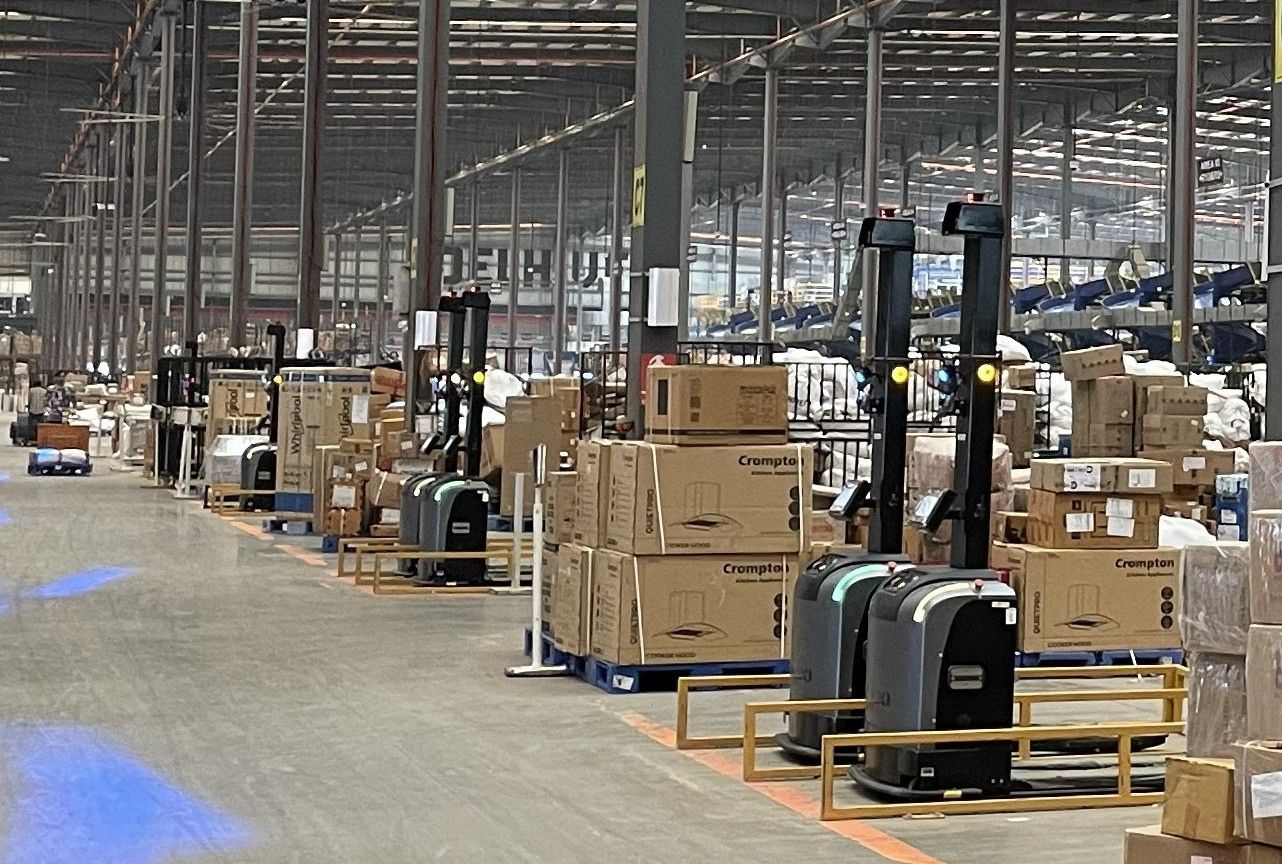 A smart warehouse is one where the physical flow of goods and the data about those goods move together in real time. Every item that enters is identified, tracked, and routed based on live system logic rather than manual instruction.
The smart warehouse concept is not about any single technology. It is about the integration between systems. A conveyor that feeds data to a WMS. A sortation system that receives routing rules from the order management platform. An AMR fleet that adjusts to real-time pick priorities.
Most warehouses become smart incrementally, not all at once. Each automation layer added creates a richer data environment for the next one.
What Are the Different Types of Sortation Systems?
Cross Belt Sorter Items sit on small individual belt carriers. When the system decides to divert, the belt on the carrier runs perpendicular to the direction of travel, sliding the item into the target lane. Cross belt sorters handle a wide range of sizes and shapes, including irregular items and polybags, with low damage rates.
Tilt Tray Sorter Similar to cross belt in structure, but the carrier tips to one side to discharge the item. Very high throughput, well-suited to smaller, uniform items like books, cosmetics, or flat parcels.
Bomb Bay / Pop-Up Sorter The carrier platform splits or opens, and the item drops into the lane below. Typically used for smaller, rigid items. High speed in compact footprints.
Sliding Shoe Sorter Small plastic shoes embedded in the conveyor surface slide diagonally to divert items. Handles heavier cartons and cases well. Commonly used in retail distribution and FMCG operations.
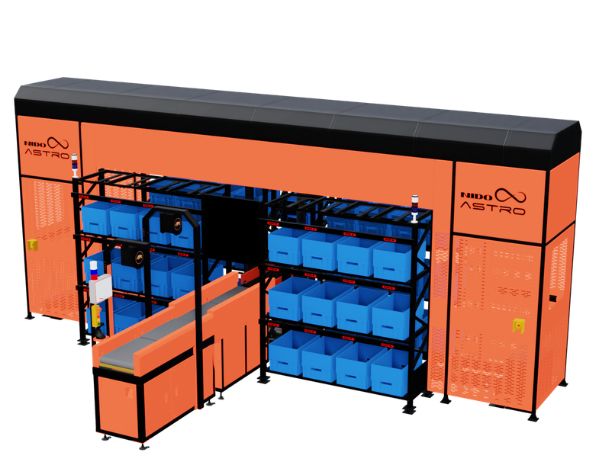 Modular Sortation Systems: Newer modular systems like NIDO’s AstroSort, combine the logic of a traditional sorter with a modular physical structure that can be deployed in sections. Capacity can be added or reconfigured without replacing the entire system. This approach suits operations that are growing but do not want to commit to a fixed large-scale installation from the start.
How Much Does Warehouse Automation Cost in India
Cost varies significantly based on the function being automated, the scale of the operation, and the level of integration required.
At the entry level, a modular conveyor line or a sortation system for a regional hub can be operational for 10 to 40 lakh INR. Mid-scale end-to-end automation projects covering receiving, storage, picking, packing, and shipping typically fall in the 1 to 5 crore range depending on facility size and throughput requirements. Large-scale ASRS or fully integrated fulfilment centre projects sit well above that.
The more useful number is not the upfront cost. It is the payback period. For most operations automating a high-volume manual function, payback typically arrives within 3 to 12 months. The faster the operation is growing, the faster the return.
Where Should an Operation Start with Automation?
The most common mistake is trying to automate everything at once, or waiting until the budget exists for a complete overhaul.
A more practical approach: find the function that is limiting throughput the most right now. That is usually the right place to start.
For a courier hub, it is often sortation. Manual sorting is the bottleneck that causes cut-off delays, errors, and SLA failures.
For a D2C fulfilment operation scaling fast, it is often picking and conveyor flow.
For a 3PL managing multiple clients in one building, it is often sortation and WMS integration, since one failure point affects multiple client SLAs simultaneously.
Start with the constraint. Automate that. Measure the impact. Then move to the next constraint.
Does Warehouse Automation Work for Mid-Sized Operations?
Yes. The assumption that automation is only for large enterprises is outdated. Modular systems have changed the economics significantly over the last five years.
A mid-sized operation processing 5,000 to 50,000 orders per day has access to modular conveyor, sortation, and AMR solutions that deploy in days, run on an existing team, and do not require a facility redesign. The era of automation requiring a five-year roadmap and a transformation budget is over for most use cases.
The relevant question is not whether you are big enough to automate. It is whether you can afford to keep growing without it.
Frequently Asked Questions
NIDO Automation is India’s end-to-end intralogistics automation partner. From conveyor systems and sortation to AMRs, packaging automation, and WMS integration, we build solutions for operations of every scale. Visit nidoworld.com to learn more.