Every logistics operation hits the same wall.
Parcels pile up faster than people can process them. Manual sorters fall behind. Errors climb. SLAs start slipping. And the gut feeling that something structural needs to change starts getting harder to ignore.
Most of the time, the problem is not the warehouse floor. It is not the software. It is sortation. The step between receiving and shipping that most operations try to manage with people and clipboards long after they have outgrown it.
This guide explains exactly what a sortation system is, how it works, and how to know whether your operation needs one.
What Is a Sortation System?
A sortation system is automated equipment that receives mixed items : parcels, packages, totes, cartons, or products : and separates them into defined groups based on specific criteria. Those criteria could be destination, size, weight, barcode, route, customer, or product category.
On This Page
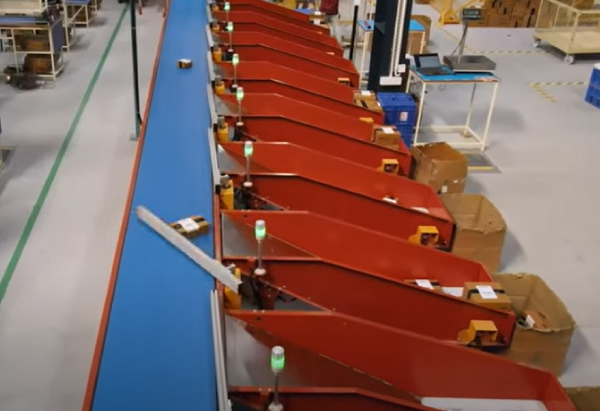 The system reads each item (usually through a barcode scan, camera, or RFID tag), makes a routing decision, and directs the item to the correct output lane or container : automatically, at speed, without a person making that call for each piece.
Sortation systems are the backbone of courier hubs, e-commerce fulfilment centres, 3PL facilities, retail distribution centres, and any operation where mixed SKUs or shipments need to be separated quickly and accurately.
How Does a Sortation System Work?
At a basic level, every sortation system has three components working together.
Induction: Items enter the system, either manually by an operator placing them on the line or automatically from an upstream conveyor. At this stage, the item is identified through a scan or read.
Sorting logic: The system’s software matches the item’s ID against the routing rules : which lane, which bin, which destination. This decision happens in milliseconds.
Divert: The item is physically moved from the main conveyor to the correct output. How it is diverted depends on the type of sorter.
That sequence : induct, decide, divert : repeats continuously, at throughputs that range from a few hundred items per hour in small operations to over 100,000 items per hour in large hub facilities.
What Are the Different Types of Sortation Systems?
Cross Belt Sorter Items sit on small individual belt carriers. When the system decides to divert, the belt on the carrier runs perpendicular to the direction of travel, sliding the item into the target lane. Cross belt sorters handle a wide range of sizes and shapes, including irregular items and polybags, with low damage rates.
 Tilt Tray Sorter Similar to cross belt in structure, but the carrier tips to one side to discharge the item. Very high throughput, well-suited to smaller, uniform items like books, cosmetics, or flat parcels.
Bomb Bay / Pop-Up Sorter The carrier platform splits or opens, and the item drops into the lane below. Typically used for smaller, rigid items. High speed in compact footprints.
Sliding Shoe Sorter Small plastic shoes embedded in the conveyor surface slide diagonally to divert items. Handles heavier cartons and cases well. Commonly used in retail distribution and FMCG operations.
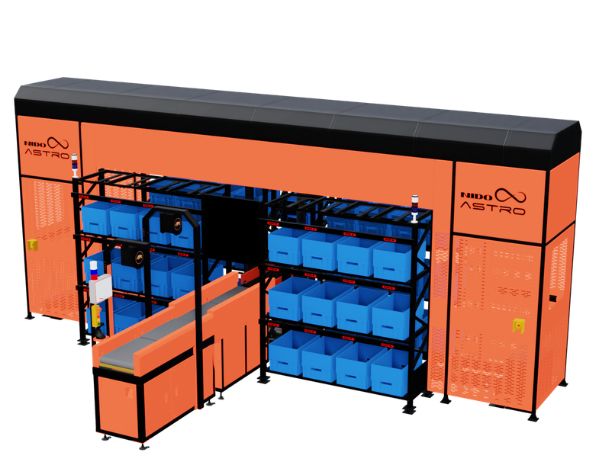
Modular Sortation Systems: Newer modular systems like NIDO’s AstroSort, combine the logic of a traditional sorter with a modular physical structure that can be deployed in sections. Capacity can be added or reconfigured without replacing the entire system. This approach suits operations that are growing but do not want to commit to a fixed large-scale installation from the start.
What Are the Different Types of Sortation Systems?
Cross Belt Sorter Items sit on small individual belt carriers. When the system decides to divert, the belt on the carrier runs perpendicular to the direction of travel, sliding the item into the target lane. Cross belt sorters handle a wide range of sizes and shapes, including irregular items and polybags, with low damage rates.
Tilt Tray Sorter Similar to cross belt in structure, but the carrier tips to one side to discharge the item. Very high throughput, well-suited to smaller, uniform items like books, cosmetics, or flat parcels.
Bomb Bay / Pop-Up Sorter The carrier platform splits or opens, and the item drops into the lane below. Typically used for smaller, rigid items. High speed in compact footprints.
Sliding Shoe Sorter Small plastic shoes embedded in the conveyor surface slide diagonally to divert items. Handles heavier cartons and cases well. Commonly used in retail distribution and FMCG operations.
Modular Sortation Systems: Newer modular systems like NIDO’s AstroSort, combine the logic of a traditional sorter with a modular physical structure that can be deployed in sections. Capacity can be added or reconfigured without replacing the entire system. This approach suits operations that are growing but do not want to commit to a fixed large-scale installation from the start.
What Is Mid-Mile Sortation?
Mid-mile sortation refers specifically to the sorting that happens between the origin facility and the final delivery point. It is the step where a mixed load of outbound shipments is broken down by route, zone, pin code, or delivery hub.
In the Indian logistics context, mid-mile sortation is often the most under-invested part of the chain. First-mile pickup and last-mile delivery receive the most operational attention. Mid-mile gets managed manually, often at regional hubs, where volume spikes around sales events or festive seasons push the process past its limits.
Getting mid-mile sortation right directly reduces cost per shipment, cut-off time pressure, and delivery failures downstream.
When Does an Operation Actually Need a Sortation System?
Sortation systems are not just for large enterprises. The right question is not “are we big enough?” It is “is manual sorting becoming the ceiling on our growth?”
A few clear signals:
- Sort accuracy is declining as volume goes up
- Peak periods (sales events, festive season) regularly cause SLA failures
- You are adding headcount to the sort floor but throughput is not keeping pace
- Errors at sortation are creating downstream re-delivery costs
- Your sort operation is the reason your cut-off times cannot move earlier
If two or more of those apply, the cost of not automating sortation is already higher than the cost of the system itself.
What Is the ROI of a Sortation System?
ROI depends on current volume, error rate, labour cost, and how close to capacity the operation is running. In most mid-scale Indian logistics operations, the financial case closes quickly because labour costs per sort cycle are high relative to automation costs.
A modular sortation system in the 10,000 to 60,000 parcel-per-day range typically delivers measurable ROI within 6 to 12 weeks of full operation, once induction errors are reduced and throughput per shift increases.
The faster an operation is growing, the faster the ROI.
Frequently Asked Questions
NIDO Automation designs and deploys sortation systems for warehouse and logistics operations across India. Our AstroSort modular sortation system handles 10,000 to 100,000 parcels per day and deploys in days, not months. Talk to our team at nidoworld.com.